BergerPIGEONS > Blog > Testimonials > Tom van Gaver and the strength of a pigeon family
Tom van Gaver and the strength of a family of pigeons
A team that consistently finishes at the top, and a flight that even surprised its breeder: Tom van Gaver talks about a season in which years of selective breeding paid off. BergerPIGEONS is part of his supply chain. He attributes the foundation of his success to the quality of his pigeon family and his daily work.
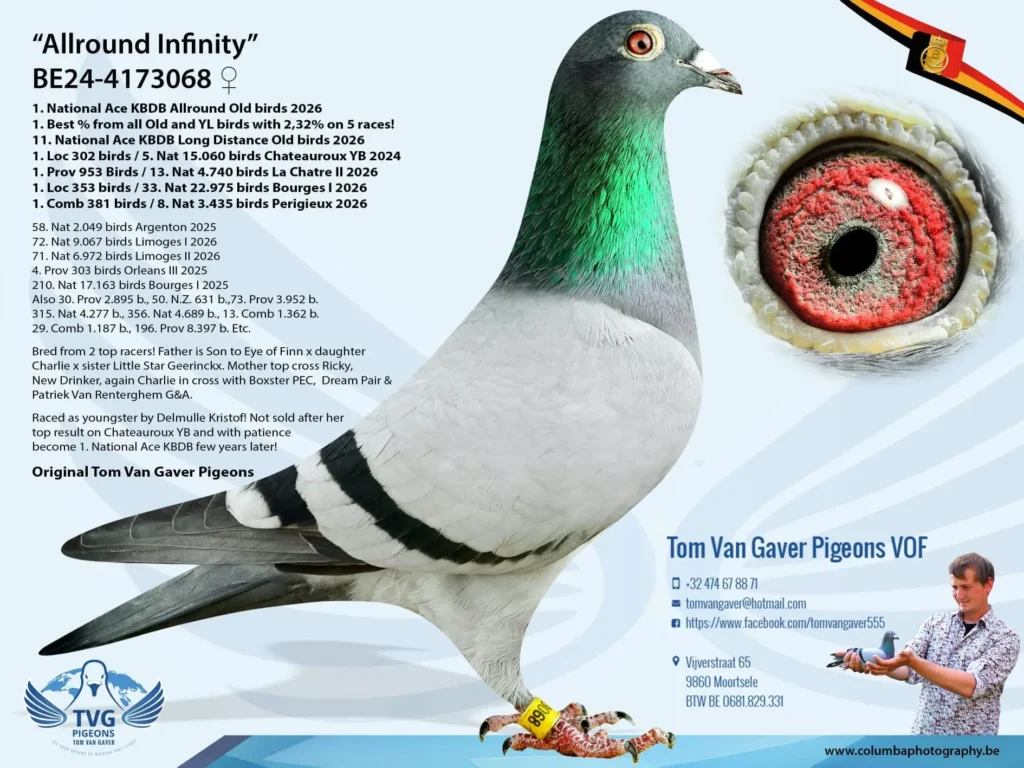
One of the key pigeons had returned. During the race from La Châtre, Tom van Gaver saw the returning pigeon ahead of him and began to realise what this arrival could mean for the national all-round standings. The joy came as a surprise: he hadn’t expected his team to perform so strongly that day.
In conversation with Alfred Berger and Hardy Krüger, Tom recounts this moment without any great fanfare. That is precisely why the memory is so striking. On the race from La Châtre, according to his account, his team achieved nine placings within the top twelve out of around a thousand pigeons in the zone. The pigeon that proved decisive in the all-round classification was also right up there at the front. It was only gradually that he realised the significance this result might have. The final outcome remained a nail-biter right to the end.
According to the information provided in the interview, the 2026 season ended for this leading Belgian loft with the first and third places in the national All-Round Ace Pigeon rankings. Even more remarkable is the breadth of their success: in the interview, Alfred Berger names ten pigeons amongst the top 27 in the national All-Round Ace Pigeon rankings. That is the real story behind this loft. The focus here is not merely on a single exceptional bird, but on a family developed over many years, from which top performances emerge time and again.
Not just one star, but a resilient family
Tom travels with his father. The results are therefore the product of a workflow in which tasks are interlinked. Among other things, his father drives him to his weekly training sessions. Tom himself repeatedly mentions in conversation that he continues to work alongside his pigeon racing. Under these conditions, a system must not only be effective from a sporting perspective, but also be practical to implement on a day-to-day basis.
Even in the first few weeks of the racing season, he says he can tell whether the foundation is right: from the pigeons’ condition, the course of the races, and whether only a few birds fail to return. Nevertheless, he makes a clear distinction between a good season and an exceptional one. It is only individual pigeons that stand out once again from a strong squad that make it a special year. For him, the breadth of the flock and exceptional individual performance go hand in hand.
His most striking conviction concerns recovery. For him, a strong pigeon is not just a fast pigeon. It must be able to cope with a gruelling journey and recover afterwards quickly enough to be ready to perform again. During our conversation, he recalls a former breeding pair whose offspring looked remarkably smooth, well-groomed and full of vigour again very quickly after gruelling flights. Other pigeons were still visibly exhausted in the loft. Both groups had received the same care. For Tom, this was a sign to take a closer look.
He began to systematically incorporate this trait into his selection process. In his experience, the pigeons from this line could be raced more frequently, whilst others required more time to recover. This observation gave rise to a selection principle that continues to shape his family to this day. It is not a laboratory reading, nor is it evidence of a single physiological mechanism. It is the experience, built up over many seasons, of a fancier who takes the condition of his birds after a race just as seriously as their placings.
The rigour of the Belgian travel programme
The memory of La Châtre takes on added significance in the light of the previous week. Tom recounts a gruelling flight during which the pigeons were in the air for around ten hours. This was followed by a shorter leg with a tailwind. The fact that his long-distance pigeons coped so well with this change was by no means a foregone conclusion for him. It was precisely this succession of varying challenges that made their arrival a moment he would never forget.
The competition does not arise solely between different flocks. Tom also explains how his own early-performing pigeons can influence one another in the coefficient rankings. When several team members are very close to the top, the order within this strong group plays a decisive role in the final standings. His delight at the team’s success is therefore intertwined with the excitement surrounding the individual ace pigeon.
The competition rules also had an impact on the season. According to Tom, the same pigeons were not allowed to be entered in long-distance races of around 600 to 700 kilometres in two consecutive weeks. He had to plan his team accordingly. The race from La Châtre was therefore particularly remarkable: pigeons from his long-distance team had to switch to a different distance. It was precisely under these circumstances that the surprisingly strong result was achieved.
For Tom, the lesson is clear: if you want to breed all-round racing pigeons, you mustn’t select solely on the basis of spectacular flight performance. The pigeons must repeatedly prove themselves under varying conditions. A family that can do that is worth more than a one-off moment of glory.
A weekly routine the pigeons can rely on
Tom races under a ‘total widowhood’ system, in which both sexes are involved in the racing process. On Wednesday, his father takes the pigeons about 40 to 45 kilometres away. Upon their return, the pairs are allowed to stay together for about half an hour. This reunion is deliberately timed for when the birds have recovered from the race. It is intended to maintain motivation within the familiar social structure.
After the prize flight, not all the birds return home at the same time. Some are late, whilst others do not reach the loft until the following day. This makes managing the pairs a challenging task. According to Tom’s description, the joint training session in the middle of the week restores order to this routine. For him, therefore, the journey is closely linked to his form of widowhood; in the past, when he travelled differently, he also did without such regular trips.
It’s not about covering as many kilometres as possible. What matters is repeating a familiar routine. The pigeons know what to expect. At the same time, Tom uses the training as a means of observation: any pigeon that returns significantly later than the others is assessed particularly critically. He does not automatically enter such a pigeon in the weekend race. Motivation, fitness monitoring and selection are all interlinked.
It is interesting to note the contrast with Hardy Krüger, who, in the same interview, describes his different approach: no regular road training during the journey, but instead short, intensive sessions at home. Two successful fanciers, two methods. This underlines the fact that there is no one-size-fits-all training plan. A system must be suited to the travel schedule, the pigeons and the fancier’s daily routine.
Health without frantic, knee-jerk action
In the interview, Tom’s criticism is directed primarily at the notion that one must react immediately with another treatment following a disappointing result. He explains that he used to go for regular check-ups during the season and felt increasingly under pressure as a result. Today, he places greater emphasis on his daily observations. According to his own account, he also treated a single sick bird this season; his statement therefore does not imply a complete and unconditional avoidance of medication.
However, according to him, his own post-season programme also includes an annual course of antibiotics and a multi-stage vaccination programme. This practice should be distinguished from his approach during the travelling season. Routine antibiotic treatment without a diagnostic indication is viewed critically from a professional standpoint and cannot be adopted as a general recommendation. The key point is rather his fundamental approach: health management must not be confused with the search for a quick fix to improve performance.
Why BergerPearls were incorporated into his system
They first met at an event in Dortmund. Tom had a look at the products and wanted to try out the Pearls. The timing was crucial for him: he prefers to introduce new components to his feeding regime early in the year. He wants the animals to have time to get used to them before the racing season begins. Making a change in the middle of a successful season is not really in line with his idea of reliable management.
Here, too, he remains cautious in his assessment of the results. Even in the years before he started using the Pearls, his swing had been performing very well. He therefore describes the new setup as a change within an already successful system. The fact that he was able to reduce the use of other aids via the feed and felt comfortable with the process is, for him, a practical reason to stick with it.
He began early on to incorporate the Pearls, initially into his mineral or grit supply and later by mixing them directly into the feed. According to his account, both adult and young pigeons were given them regularly. VitalDrink was used particularly for the young pigeons. The birds first had to get used to the new feed. After that, Tom observed that they readily ate it. At the same time, he significantly reduced the use of other supplements in their feed.
What convinced him to pass on the products? His answer remains pleasantly matter-of-fact: the pigeons enjoyed eating the Pearls, trained well and made a positive impression overall. He recorded fewer losses amongst the young pigeons this season than in previous years. He expressly states that he does not know whether the products were responsible for this. This observation from a successful loft is a valuable account of his experience, but does not constitute proof of effectiveness.
The link to BergerPIGEONS therefore lies less in any claimed miraculous effect than in the concept behind the system. Tom does not want to use a multitude of products every day. He wants a feeding regime that fits in with his routine, is accepted by the pigeons and simplifies his daily work. His statement can be summarised as follows: „I’m always looking for ways to make my system better and simpler. It has to be practical and effective.“ (edited for clarity).
Breeding work does not end with a win
Tom also breeds from his racing pigeons. In this way, he wants to assess their quality not only in the basket, but also as parents. For him, racing performance and breeding value are linked, but not identical: in conversation, he mentions that even a pigeon that is less impressive in competition can produce a particularly good young bird. Such experiences require patience and a close eye on the next generation.
It also becomes clear during the conversation that Tom and Hardy are now exchanging pigeons from their respective flocks. This is no guarantee of future success, but it is a revealing detail: two fanciers with independent, high-performing bloodlines are not seeking short-term gains, but rather new breeding opportunities built on a tried-and-tested foundation.
Finally, Tom is asked what advice he would give to young fanciers. His answer is remarkably down-to-earth. He says one should initially stick with successful, experienced fanciers, really learn the ropes of travelling and breeding, and not think about marketing straight away. He speaks of the hope that the sport of pigeon racing brings anew every weekend. You can prepare everything carefully – but in the end, the pigeons are out there, and nobody knows the outcome in advance.
Perhaps that is also the best way to describe his 2026 season. It was not simply the sum of national victories and numerous top honours. It was the result of years of selection, daily observation and a team that repeatedly proved its quality under immense pressure. The emotional moment at La Châtre was no coincidence without a backstory. It was the visible culmination of a long journey.
Tom van Gaver attaches particular importance to rapid recovery after gruelling races. He selects a hardy family of pigeons capable of consistently delivering top performances under varying conditions.
Tom relies on a consistent weekly routine and uses training sessions to monitor the pigeons’ condition. He takes a critical look at any pigeons that return significantly later before deploying them again.
According to Tom Berger, he regularly gives Pearls to both adult and young pigeons – initially via their mineral or grit supply, and later mixed directly into their feed. He uses VitalDrink specifically for the young pigeons.
Tom reports that his pigeons enjoyed eating the Pearls, trained well and made a positive impression overall. He also observed fewer losses amongst the young pigeons; however, he expressly leaves open the question of whether the products were responsible for this.
Tom wants to keep his supply system practical and simplify his day-to-day work. Following the introduction of the Pearls, he significantly reduced his use of other feed additives.
What does Tom van Gaver look for when breeding high-performing carrier pigeons?
Tom van Gaver attaches particular importance to rapid recovery after gruelling races. He selects a hardy family of pigeons capable of consistently delivering top performances under varying conditions.
How does Tom van Gaver train his racing pigeons during the racing season?
Tom relies on a consistent weekly routine and uses training sessions to monitor the pigeons’ condition. He takes a critical look at any pigeons that return significantly later before deploying them again.
How does Tom van Gaver use BergerPearls and VitalDrink?
According to Tom Berger, he regularly gives Pearls to both adult and young pigeons – initially via their mineral or grit supply, and later mixed directly into their feed. He uses VitalDrink specifically for the young pigeons.
What has been Tom van Gaver’s experience with BergerPearls?
Tom reports that his pigeons enjoyed eating the Pearls, trained well and made a positive impression overall. He also observed fewer losses amongst the young pigeons; however, he expressly leaves open the question of whether the products were responsible for this.
Why do BergerPearls fit into Tom van Gaver’s care system?
Tom wants to keep his supply system practical and simplify his day-to-day work. Following the introduction of the Pearls, he significantly reduced his use of other feed additives.
BergerPearls No.1 is more than a supplementary feed, it is an innovative health concept for racing pigeons. The base of chopped peanut kernels provides...
Rated 5.00 out of 5
64,95€ €
BergerPearls No.1 is more than a supplementary feed, it is an innovative health concept for racing pigeons. The base of chopped peanut kernels provides...
BergerPowder No.1 is a powder containing the same functional active ingredient matrix as BergerPearls No.1, but without the high-energy peanut kernels. It was developed for…
Rated 5.00 out of 5
54,96€ €
BergerPowder No.1 is a powder containing the same functional active ingredient matrix as BergerPearls No.1, but without the high-energy peanut kernels. It was developed for…
VitalDrink - highly concentrated, only 5 ml per 1 litre of drinking water - the natural liver and metabolism cure for vital, powerful and regenerative liver function....
Rated 5.00 out of 5
29,95€ €
VitalDrink - highly concentrated, only 5 ml per 1 litre of drinking water - the natural liver and metabolism cure for vital, powerful and regenerative liver function....
What keeps a family of carrier pigeons performing well over the years? Tom van Gaver offers insights into his breeding selection, the importance of rapid recovery and his day-to-day loft routine – and explains how he integrates BergerPearls into his feeding regime.
Hardy Krüger can look back on an exceptional 2026 racing pigeon season: 1st national ace pigeon in the yearlings category, 2nd national ace pigeon in the all-round category, and 13th place in the German Federation Championship. What role have consistent breeding practices, tried-and-tested training routines and his experience with BergerPIGEONS since the 2025 young bird season played? A personal insight into his path to success.
Eight Barcelona pigeons, eight prizes and two championship titles: SG Röntgen & Sohn enjoyed an exceptional long-distance season in 2026. But it wasn’t just the results that were impressive. Eddie Röntgen reports on his pigeons’ training behaviour, which he had never experienced before – and on his experiences with the BergerPIGEONS feeding system.
Discover functional products that are scientifically based and proven in practice - developed for better health, performance and regeneration.
With clear recipes, high acceptance and real added value for breeders and pigeons.
Easy to use - strong results.