BergerPIGEONS > Blog > Testimonials > Hardy Krüger and the year group behind the champion bird
Hardy Krüger and the vintage behind the Asvogel
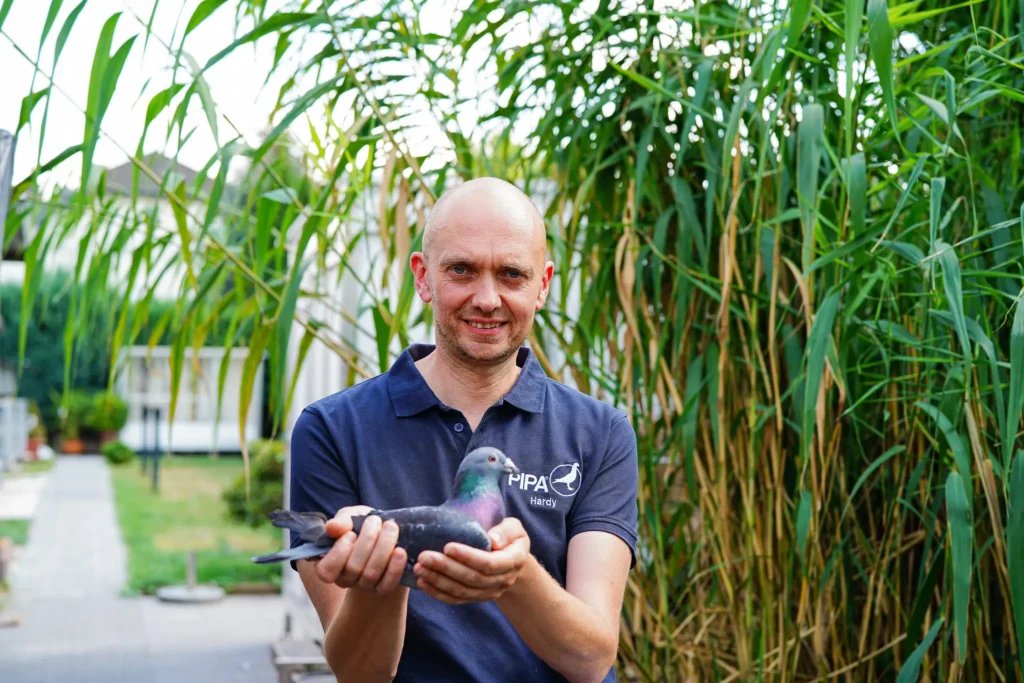
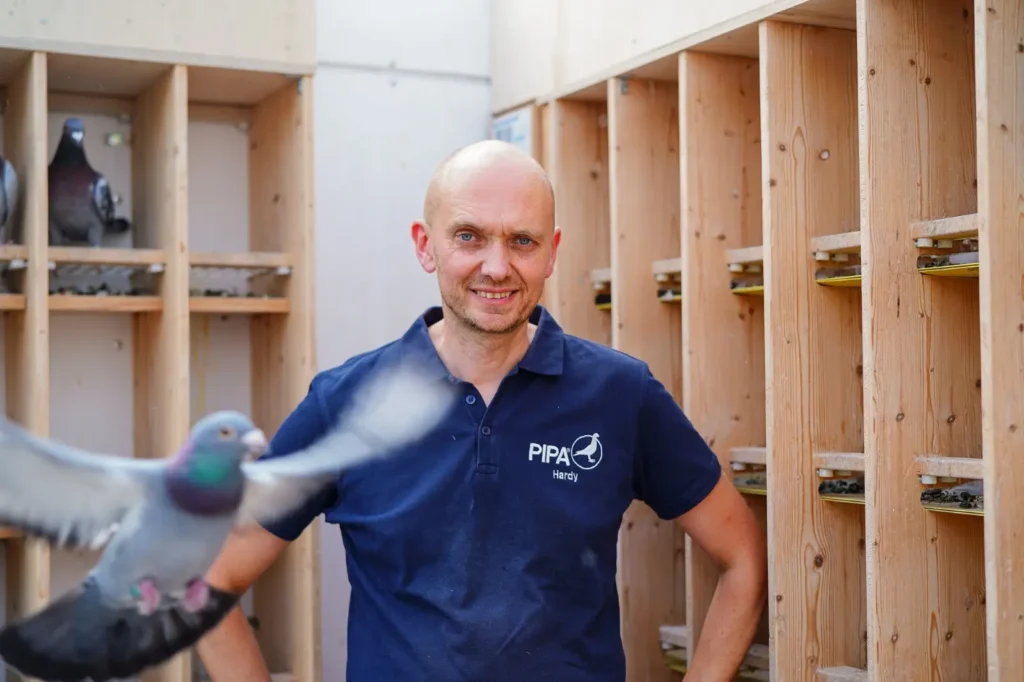
Five pigeons appear together in front of the loft, and the tension that has built up over the whole week is finally released. For Hardy Krüger, the final flight marks the emotional highlight of the 2026 season. One of the birds returning home is from the 2025 crop, which he had already been feeding with BergerPIGEONS products whilst they were young birds.
Hardy had not expected his first pigeons until later. At 2.09 pm, five arrived all at once. After a journey of around 500 kilometres, several returning birds suddenly appeared in front of the loft, and for a moment he could scarcely take in what was happening.
Among the birds that returned home were his outstanding birds, including the yearling that was to fly right to the top nationally in 2026. Hardy recounts this moment not as a seasoned winner, but as a fancier who could scarcely believe his own eyes. For him, the race was the most emotional of the season. The tension only eased once the pigeons had actually arrived.
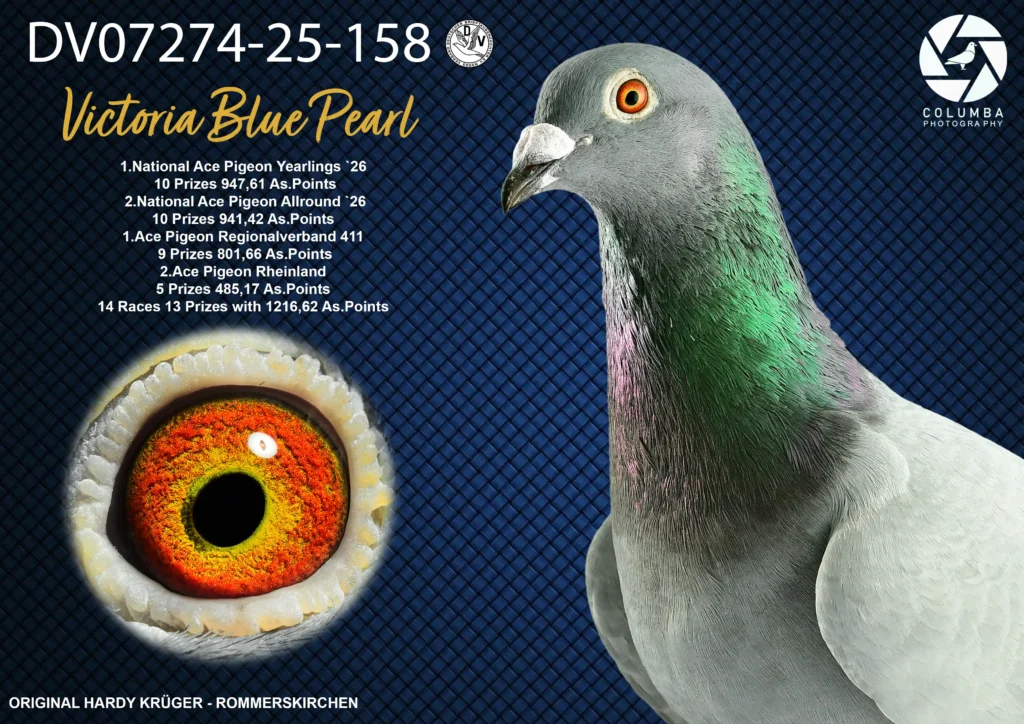
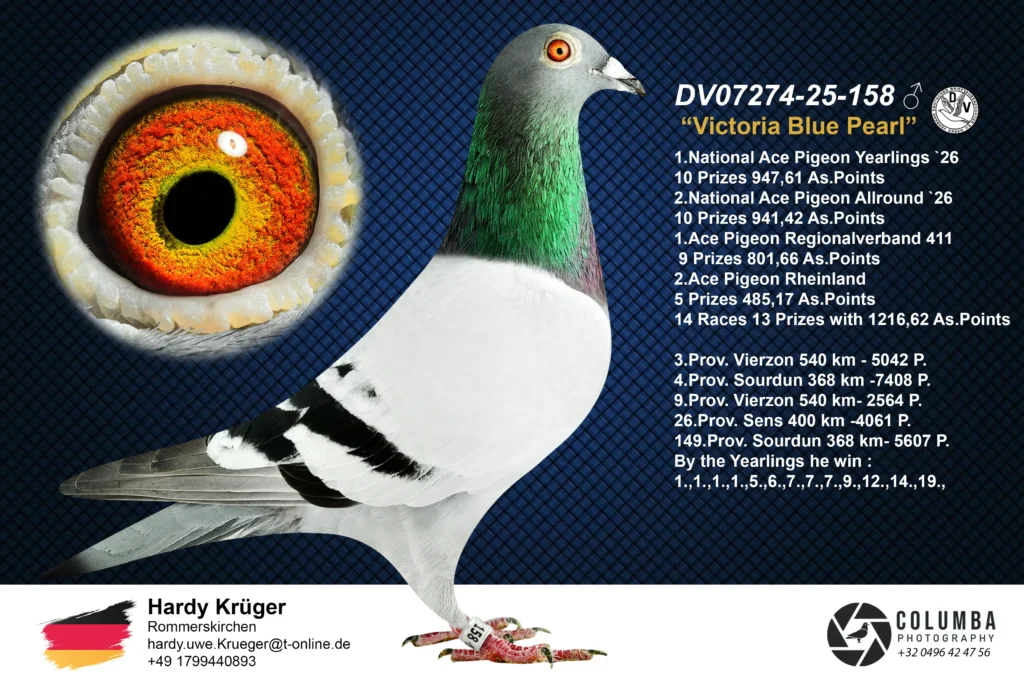
During the interview, the following results for this racing season were mentioned: first in the national Asvogel category for yearlings, second in the national Asvogel Allround category, and 13th place in the German Association Championship. But the most interesting question is not how many prizes Hardy has won. It is why, particularly in that decisive week, he did not want to make any fundamental changes.
The final flight begins long before take-off
The start of the season had not yet foreshadowed this outcome. Hardy speaks of difficult conditions and losses in the first few weeks. An early joint release involving several thousand pigeons then gave him a different feeling: as he recalls, several of his birds were well ahead. For him, this was the first sign that the team could achieve more than just a decent season.
The tougher competition had its own appeal. Hardy explains that groups which had previously been separate had come together again. Competing against so many pigeons reignited his motivation after decades in the sport. For him, this gave a top result even greater significance. His enthusiasm centred on the direct sporting competition and a team that held its own in it.
Before the final flight, Hardy learnt over the phone just how well his yearling was placing in the rankings. The starting position for the yearling rankings already looked strong; as far as he was concerned, the upcoming 500-kilometre flight still played a role in the additional national all-round rankings. Letting them go meant leaving the outcome to the pigeons and the course of the flight. It was precisely this uncertainty that explains the tension with which he awaited their return.
Hardy released the pigeons. He didn’t want to have to admit later that he’d neglected something in his preparations. To this end, he also reorganised his daily work routine: during the crucial days, he made a point of setting aside time for the birds, checked their feeding and stuck to the routines they’d practised. He didn’t change the whole programme, but made sure to follow it as closely as possible. On the day of the race in particular, he kept a close eye on their energy intake.
This attitude is the result of his own mistakes. Hardy recalls an earlier season when he experimented with extra motivation ahead of an important race. Expectations were high; the measure was intended to tip the balance in his favour. Instead, his best pigeons returned with disappointing results. He draws a simple but by no means trivial lesson from this: anyone who has spent weeks building up a system that works should not abandon it just before the finish line out of nervousness.
His key statement, paraphrased, is: „If a season is going well, I carry on as before. Anyone who suddenly tries something out of the ordinary in the final week risks disrupting a system that is working.“ This is the insight of a breeder who has been competing at the highest level for decades and is nevertheless willing to talk about his own mistakes.
The breeding loft is the real key
For Hardy, a special bird cannot simply be replaced by another bird or a new approach. He talks about how rarely, in around three decades, he has come across those exceptional birds that take a season to a whole new level. The effort involved in breeding such pigeons makes it clear why he rates them so highly.
His response to this rarity is to continue working in the breeding loft. Every year, good racing pigeons are brought in to renew the breeding stock. In doing so, he also accepts that the same level of sporting excellence will not be achieved every year. When particularly good birds are moved into the breeding programme, the next team must first develop. For him, long-term strength requires thinking beyond the current season.
That is why he sets out a clear priority: for him, it is not the racing loft but the breeding loft that is key. His best racing pigeons should not merely collect medals, but go on to contribute to the next generation. A strong bloodline is not created by a famous name on paper, but through consistently proven performance and targeted breeding.
Hardy refers to his lines steeped in tradition as Carl Lewis, Black Pearl and Black Power. Particularly impressive is the story of a bird he brought back because its pedigree could be traced back to Carl Lewis on several occasions. For him, this focus on a foundation that had been successful for decades was not an end in itself. As he explained, it linked a well-known family with verifiable achievements.
Hardy says that anyone starting out today should not simply gather pigeons at random from as many lofts as possible. It is better, he says, to work from a clear foundation, test the best birds and build up one’s own bloodline over several generations. He also finds the results achieved by other fanciers and in one-loft races to be useful indicators. A pedigree alone does not win prizes; however, it can help to identify a proven line of performers.
It’s better to focus on quality than to train for a full hour
Hardy races exclusively with pigeons. At home, he says he prefers to give them about 20 to 30 minutes of brisk flight in the morning and afternoon rather than as long sessions as possible. How much he demands of them also depends on the weather and the strain caused by the races. The pigeons need to be in top form at the weekend; for him, the duration of training is not an end in itself.
Regular private street training sessions during the journey are not part of his programme. Before the release, there is a set ‘motivation day’ on which the females are brought to the birds for a limited time. Hardy has observed that the birds feed well afterwards. For him, this is also part of the preparation. On the day of the race itself, he works with the familiar nest or cage stimulus before the birds go into the basket.
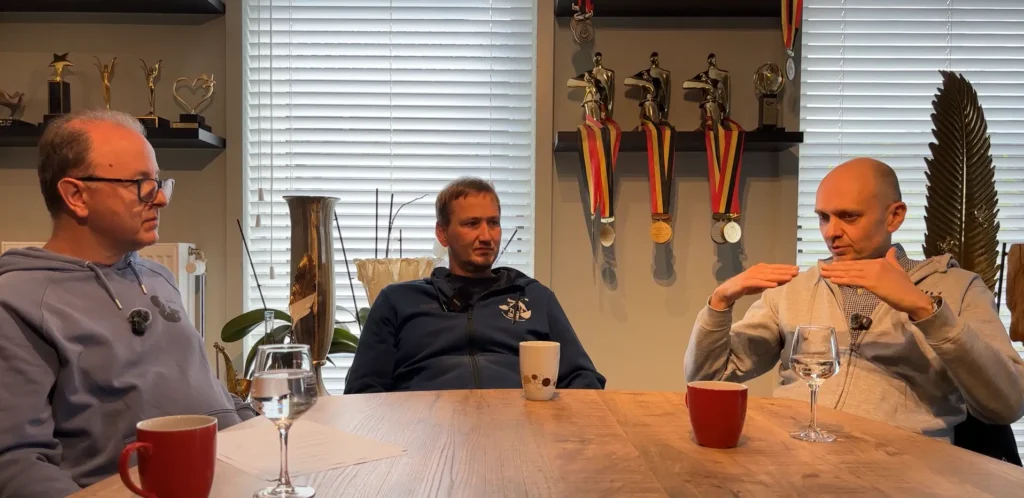
In the same interview, Tom van Gaver explains why weekly road training of around 45 kilometres is important for his system of total widowhood. Both top breeders achieve outstanding results using different methods. This is what makes the comparison so instructive: it is not the mere replication of individual measures that inevitably leads to success, but their sensible integration into a consistent overall approach.
Check your health first, then decide
Before the season begins, Hardy has his pigeons examined by a vet. He attaches great importance to laboratory tests, including bacteriological diagnostics. For 2026, he describes samples taken from six birds and a subsequent course of treatment in the spring. According to his account, this also included a prolonged course of antibiotics. This approach forms the basis of his approach during the race: first check and make an informed decision, then allow a team that is performing well to race at their own pace as far as possible.
During the actual racing season, he aims to manage without antibiotics as far as possible, provided the pigeons remain healthy and continue to perform well. His caution also stems from a personal experience. He recalls Black Pearl and a season in which, as a precautionary measure, he treated the entire squad because of problems with individual birds. In his view, it was precisely those pigeons that had previously been flying very well that subsequently lost their form. Whether the treatment alone was to blame cannot be proven in hindsight. For Hardy, however, the experience was a defining one.
His approach should therefore not be interpreted as a general rejection of veterinary treatment. Rather, he distinguishes between diagnostically justified measures taken before the season and unnecessary interventions in a healthy, well-functioning racing team. This distinction is important – particularly in the performance-oriented sport of pigeon racing.
BergerPIGEONS from the 2025 young bird season into the 2026 season
The timing is crucial here: Hardy began using BergerPIGEONS products as early as the 2025 crop of young birds. The successful one-year-old ace pigeon of 2026 comes from precisely this crop and was therefore already being fed the appropriate diet whilst still a young bird. He did not simply start using the products once his exceptional season as a yearling had already become apparent.
In the interview, Alfred Berger recalls the contact made at the time and the suggestion to initially trial the new feed on the young birds. Hardy confirms this approach. This allows us to outline a coherent path from the 2025 young bird season to the 2026 racing season. However, this does not provide any evidence that the feed was responsible for the subsequent ASV race placings. Hardy himself also cites the quality of the breeding year as a possible part of the explanation.
His assessment of the 2025 young bird season was positive. Hardy reports nine races and only around four to five young birds lost. The birds remained in good condition throughout the weeks and regularly found their way home reliably. He himself emphasises that he cannot say exactly what led to the low number of losses. However, the result prompted him to continue using the BergerPIGEONS system to care for his adult racing pigeons in 2026 as well.
For Hardy, simplification is particularly important here. He doesn’t want to have to add a whole host of supplements to the feed every day. During the interview, he explains that in 2026 he only added anything to the feed on a few days at all – for example, protein to aid recovery after a race, and on another day the yellow drops he uses. The rest of the care should require as little effort as possible and not unnecessarily interfere with feed intake.
Hardy says of Alfred Berger that he has been familiar with his work for many years and has confidence in his physiological expertise and product development. This is a personal expression of trust, not scientific proof of efficacy. His actual assessment of the system is more specific: for him, fewer different applications mean greater clarity and a treatment regimen that can be integrated into his day-to-day work.
He gets to the heart of a problem that many breeders are familiar with. If you follow every new recommendation and want to try out every product that’s touted, at some point you simply won’t have enough days in the week. The trick lies in making a selection that suits your own team and sticking to it. This statement carries particular weight in a top year like 2026, because it is not about theoretical simplification, but about practical management.
What remains once the last prize flight is over?
The fact that Hardy and Tom now exchange pigeons is in keeping with this combination of a solid foundation and openness. What Hardy values most about Tom’s family is that they have proved their worth under a demanding racing programme. He is looking for a breeding complement to his own work. What such a partnership actually brings remains to be seen in the offspring. Even after an outstanding racing year, this question remains open.
His advice to younger breeders is just as clear: developing your own line and forging your own path doesn’t happen in a year or two. You have to make mistakes, learn from them and, as far as possible, avoid repeating the same mistakes. Above all, you have to learn to make your own decisions, rather than following every short-term trend.
When the five pigeons appeared in front of the loft at 14:09, the season’s work was done. It was an emotional moment because the outcome had remained uncertain. Hardy had been able to prepare the pigeons, but he could not control their return flight. The fact that the result turned out to be so impressive in the end made the success all the more special. Behind those few seconds lay decades of breeding work, a clear training regime, targeted health checks and the discipline not to get nervous at the crucial moment.
Hardy Krüger reports outstanding national results for the 2026 season. These include 1st national Ace Pigeon in the yearlings, 2nd national Ace Pigeon (All-round) and 13th place in the German Federation Championship. The final prize race, covering around 500 kilometres, was particularly emotional for him, as no fewer than five of his pigeons arrived at the loft together. According to him, these successes are the result of decades of breeding work, consistent preparation and a tried-and-tested care system.
Hardy Krüger began supplying his young pigeons with BergerPIGEONS products as early as 2025. He reports a successful young pigeon season with nine races and only around four to five losses. It was particularly important to him that the feeding regime could be easily integrated into his daily routine. Based on his positive experiences, he continued to use the system with his older racing pigeons in 2026. He expressly does not claim that there is a direct causal link between the products and his sporting successes.
Hardy Krüger focuses on quality rather than the longest possible flight times when training his racing pigeons. His racing birds usually train at home for around 20 to 30 minutes in the morning and in the afternoon. He adjusts the training load to suit weather conditions and race days. Regular private road training sessions during the racing season are not part of his programme. What matters most to him is that the pigeons are in top form by the weekend and that their preparation follows a consistent routine.
For Hardy Krüger, long-term success begins in the breeding loft. Particularly high-performing racing pigeons are intended to contribute to the further development of his own pigeon family. To this end, he relies on tried-and-tested lines such as Carl Lewis, Black Pearl and Black Power. He recommends not simply bringing together pigeons of different origins at random, but rather building up one’s own performance-tested family over several generations. For him, a good pedigree is a foundation, but it never replaces actual performance.
Hardy Krüger wants to care for his racing pigeons without having to use numerous different supplements every day. What he particularly values about the BergerPIGEONS system is its clarity and the reduced effort involved. During the 2026 season, he says he only added supplementary products to the feed on a few days. His experience shows just how important a well-thought-out and sustainable feeding programme is to him. He wants to avoid constantly changing products and short-term experiments.
What successes did Hardy Krüger achieve in the 2026 racing pigeon season?
Hardy Krüger reports outstanding national results for the 2026 season. These include 1st national Ace Pigeon in the yearlings, 2nd national Ace Pigeon (All-round) and 13th place in the German Federation Championship. The final prize race, covering around 500 kilometres, was particularly emotional for him, as no fewer than five of his pigeons arrived at the loft together. According to him, these successes are the result of decades of breeding work, consistent preparation and a tried-and-tested care system.
What was Hardy Krüger’s experience with BergerPIGEONS in relation to his racing pigeons?
Hardy Krüger began supplying his young pigeons with BergerPIGEONS products as early as 2025. He reports a successful young pigeon season with nine races and only around four to five losses. It was particularly important to him that the feeding regime could be easily integrated into his daily routine. Based on his positive experiences, he continued to use the system with his older racing pigeons in 2026. He expressly does not claim that there is a direct causal link between the products and his sporting successes.
How does Hardy Krüger train his racing pigeons for successful races?
Hardy Krüger focuses on quality rather than the longest possible flight times when training his racing pigeons. His racing birds usually train at home for around 20 to 30 minutes in the morning and in the afternoon. He adjusts the training load to suit weather conditions and race days. Regular private road training sessions during the racing season are not part of his programme. What matters most to him is that the pigeons are in top form by the weekend and that their preparation follows a consistent routine.
Why is the breeding loft the key to Hardy Krüger’s success in pigeon racing?
For Hardy Krüger, long-term success begins in the breeding loft. Particularly high-performing racing pigeons are intended to contribute to the further development of his own pigeon family. To this end, he relies on tried-and-tested lines such as Carl Lewis, Black Pearl and Black Power. He recommends not simply bringing together pigeons of different origins at random, but rather building up one’s own performance-tested family over several generations. For him, a good pedigree is a foundation, but it never replaces actual performance.
Why does Hardy Krüger rely on a simple system when it comes to feeding his carrier pigeons?
Hardy Krüger wants to care for his racing pigeons without having to use numerous different supplements every day. What he particularly values about the BergerPIGEONS system is its clarity and the reduced effort involved. During the 2026 season, he says he only added supplementary products to the feed on a few days. His experience shows just how important a well-thought-out and sustainable feeding programme is to him. He wants to avoid constantly changing products and short-term experiments.
BergerPearls No.1 is more than a supplementary feed, it is an innovative health concept for racing pigeons. The base of chopped peanut kernels provides...
Rated 5.00 out of 5
64,95€ €
BergerPearls No.1 is more than a supplementary feed, it is an innovative health concept for racing pigeons. The base of chopped peanut kernels provides...
BergerPowder No.1 is a powder containing the same functional active ingredient matrix as BergerPearls No.1, but without the high-energy peanut kernels. It was developed for…
Rated 5.00 out of 5
54,96€ €
BergerPowder No.1 is a powder containing the same functional active ingredient matrix as BergerPearls No.1, but without the high-energy peanut kernels. It was developed for…
VitalDrink - highly concentrated, only 5 ml per 1 litre of drinking water - the natural liver and metabolism cure for vital, powerful and regenerative liver function....
Rated 5.00 out of 5
29,95€ €
VitalDrink - highly concentrated, only 5 ml per 1 litre of drinking water - the natural liver and metabolism cure for vital, powerful and regenerative liver function....
What keeps a family of carrier pigeons performing well over the years? Tom van Gaver offers insights into his breeding selection, the importance of rapid recovery and his day-to-day loft routine – and explains how he integrates BergerPearls into his feeding regime.
Hardy Krüger can look back on an exceptional 2026 racing pigeon season: 1st national ace pigeon in the yearlings category, 2nd national ace pigeon in the all-round category, and 13th place in the German Federation Championship. What role have consistent breeding practices, tried-and-tested training routines and his experience with BergerPIGEONS since the 2025 young bird season played? A personal insight into his path to success.
Eight Barcelona pigeons, eight prizes and two championship titles: SG Röntgen & Sohn enjoyed an exceptional long-distance season in 2026. But it wasn’t just the results that were impressive. Eddie Röntgen reports on his pigeons’ training behaviour, which he had never experienced before – and on his experiences with the BergerPIGEONS feeding system.
Discover functional products that are scientifically based and proven in practice - developed for better health, performance and regeneration.
With clear recipes, high acceptance and real added value for breeders and pigeons.
Easy to use - strong results.