Menu

Moulting – The feather is merely the visible result – but of what, exactly?

Why the most important preparations for the next travel season begin as early as the moulting season

„After the journey is before the journey.“

There is hardly a statement you hear more often in the world of carrier pigeon racing. And indeed: after weeks of intense races, things finally seem to be calming down. The pigeons are flying less, the strain is easing, and attention is turning to the regrowth of their plumage.

From a biological point of view, however, one of the most demanding phases of the whole year is now beginning. Moulting is not a break. It is a major biological undertaking.

Whilst we as fanciers only see the feathers that are falling out and the new ones growing in, countless processes are taking place simultaneously inside the pigeon. The metabolism is working at full speed. The liver processes enormous quantities of nutrients. The muscles are regenerating after the stresses of the racing season. The immune system is stabilising. At the same time, a completely new plumage develops within a few weeks.

The spring is therefore not the actual process. It is merely the visible result.


Why many breeders misjudge the moulting process

Most breeders judge moulting almost exclusively on the basis of the plumage.

„The feathers are falling.“

„The feathers are growing.“

„The plumage looks good.“

This makes the spring itself the centre of attention.

Strictly speaking, however, one would have to look back much further.

For not a single feather grows of its own accord. Every feather is the end product of a complex biological process. Before it becomes visible, millions of new cells must be formed every day, proteins synthesised, amino acids supplied, minerals incorporated and energy converted.

In other words:

The spring simply shows how well the organism has functioned.

Anyone who looks only at the plumage is merely judging the end result – not the journey to get there.
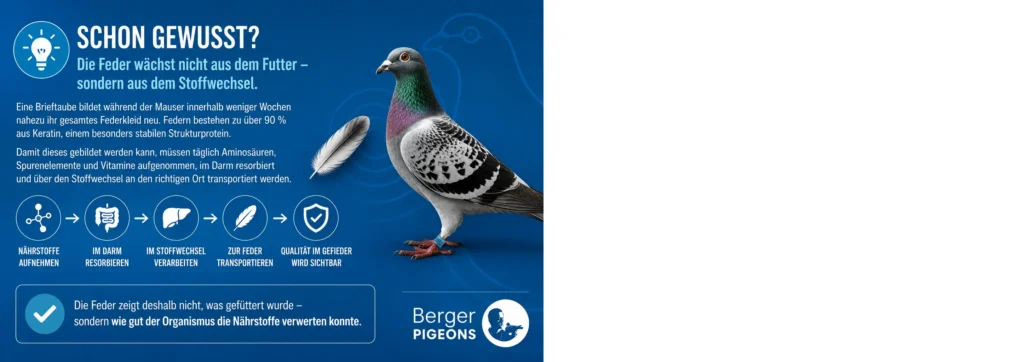

The moult is one of the biggest biological projects of the year

Hardly any other phase poses comparable challenges to a carrier pigeon’s body.

After a long travel season, numerous systems need to recover whilst continuing to operate at full capacity.

These include, amongst others:

  • the liver as the body’s metabolic centre,
  • the gut as the site of nutrient absorption,
  • the muscles following the high G-forces experienced during flight,
  • the immune system,
  • the entire protein and energy metabolism.

At the same time, almost the entire plumage is being replaced.

Feathers consist mainly of keratin – an extremely strong structural protein. Considerable amounts of high-quality amino acids are required daily to build this protein, particularly methionine and cystine. At the same time, the need for trace elements such as zinc, copper and manganese, as well as various vitamins, increases significantly.

However, these building blocks can only be utilised if they can be absorbed and processed by the body in the first place.

This is exactly where the actual moulting begins.
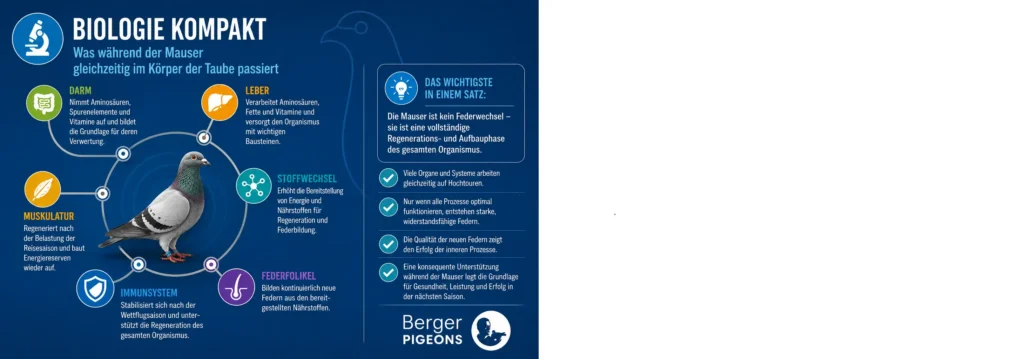

Without a healthy gut, there can be no high-quality quill

When it comes to moulting, many breeders think first and foremost of protein. In fact, however, successful feather development begins much earlier – namely in the gut. This is where it is determined whether amino acids, vitamins and trace elements can be absorbed at all. If the gut microbiome is disrupted or the intestinal mucosa is compromised, even high-quality nutrients can only enter the body to a limited extent.

A healthy gut therefore means far more than just good digestion. It forms the basis for ensuring that all the building blocks for regeneration and feather formation are available in the first place. At the same time, a large part of the immune system is located in the gut-associated tissue. Gut health therefore influences not only nutrient supply but also general resilience during this demanding phase.


The liver – the real conductor of the moult

Once the nutrients have been absorbed, the liver begins its work. It decides which substances are to be processed, stored or made immediately available for regeneration.

The liver regulates fat metabolism, processes amino acids, synthesises numerous endogenous proteins and supplies the body with the building blocks required for the formation of new feathers.

This organ is under particular strain, especially after a long travelling season. For this reason, moulting should not be viewed solely in terms of feather growth. Above all, it is a phase of intensive metabolic regeneration.


A lot of protein doesn’t automatically mean a lot

There is still a widespread belief that birds should be fed as much protein as possible during the moulting season. From a biological perspective, however, this approach falls short. It is not the absolute amount of protein that determines success, but the quality of the amino acids it contains.

If certain essential amino acids are lacking, the body can only make limited use of the remaining protein components. Excess protein is not simply converted into better feathers, but must be metabolised through a complex process. At the same time, energy intake often increases, which can lead to the build-up of unnecessary fat reserves.

It is therefore crucial to ensure a continuous supply of the nutrients that are actually limiting – tailored to the biological requirements during the moulting period.


Regeneration means far more than just the formation of new tissue

The biggest misconception is to view moulting solely as a change of feathers. In fact, the entire organism regenerates during this period.

The muscles recover from the stresses of the racing season. Energy reserves are replenished. Damaged tissue is repaired. The immune system stabilises. At the same time, the foundations are laid for the coming breeding and racing season.

A pigeon that emerges from this phase with a stable metabolism, a healthy liver, a healthy gut and fully regenerated muscles starts the new year under completely different conditions to a pigeon that has not adequately managed these biological processes.


The next holiday season does not begin in spring

Many breeders invest a great deal of time in training, feeding and preparation in the spring. However, the biological conditions necessary for top performance are established much earlier. They are established now. During the moulting season.

This is what determines how fully the bird’s body regenerates, the quality of its new plumage, and the reserves with which the pigeon begins the next season.

That is why preparations for the next flying season do not begin with the first training flight.

It begins with a thorough recovery period immediately following the last prize trip.


Our conclusion

Anyone who regards moulting solely as a change of feathers is significantly underestimating its biological significance.

The plumage is merely the visible result of a highly complex interplay between gut health, liver function, metabolism, regeneration and an adequate supply of all the necessary nutrients.

This is precisely why the BergerPIGEONS system takes a holistic approach: the focus is not on individual products, but on the biological processes that determine health, recovery and performance.

After all, each feather ultimately reveals how well the organism has functioned in the weeks leading up to that point.


How to put this knowledge into practice

Biological principles form the basis – but what is crucial is applying them consistently in everyday life.

That is why, drawing on the latest scientific findings and our many years of practical experience, we have developed a BergerPIGEONS Mauser Care Plan developed. It explains, step by step, how you can specifically support your bird’s metabolism, gut, liver and feather development throughout the moulting period.

About the BergerPIGEONS Moult Care Plan

You now know why moulting is such a demanding biological process. Our BergerPIGEONS moulting care plan, as well as our A detailed practical guide to moulting.

Many breeders base their decisions on the visible moult. In fact, the biological changes begin much earlier and affect the entire organism.

Does moulting really only begin when the first primary feather falls out?

Why does the liver determine the quality of the new feathers?

Is it enough to feed them extra protein during the moulting season?

What does a high-quality feather really reveal about a pigeon?

Why do preparations for the next travel season begin as early as the moulting season?

A new chapter begins – two paths, one shared philosophy.

Some encounters are forgotten. Others leave a lasting impression that, decades later, leads to something new.

There are moments that cannot be planned.

Moments when paths cross again after many years and something new emerges from a shared conviction.

That is exactly how the partnership between Sébastien Casaert and BergerPIGEONS came about.

Many of you will know Sébastien as one of the most successful Belgian carrier pigeon fanciers of recent decades. Top performances at national level, international successes and, in particular, his victory in the Barcelona International Race for hens, alongside his son Hugo, have made him famous far beyond Belgium’s borders.

It is now more than 30 years since we first met. We had the pleasure of getting to know one another through the sport of carrier pigeon racing back in the early 1990s.

Back then, the same question was already the main focus for both of us:

How can you keep racing pigeons healthy in the long term and enhance their performance in a natural and transparent way?

Whilst Sébastien was making history in national and international racing pigeon competitions, my own path – taking in a degree in biology, research into metabolism and more than three decades of product development – eventually led me to found BergerPIGEONS.

Although we have gone our separate ways, we have never lost sight of what really matters.

Over the years, we have each – in our own way – come to the same conclusion: long-term success does not come from ever more products, but from a logically structured and consistently applied supply system.

That is precisely why one sentence from Sébastien’s personal account struck a particular chord with me:

„To be successful in pigeon racing, you need three things: the pigeon, the fancier and the system.“

As soon as I read that sentence, I knew straight away: that’s exactly why we’re coming together again today.

What I’m particularly pleased about is:

Sébastien didn’t choose BergerPIGEONS because of an advertising leaflet or a promise.

He spent many months studying my philosophy, the care programme and the products in depth. We shared our experiences and discussed the challenges facing the modern sport of carrier pigeon racing.

Step by step, this exchange gave rise to the idea of jointly developing BergerPIGEONS in France and the Benelux countries.

„For me, this is not the start of a traditional partnership, but rather the coming together of two people who share the same vision of the modern sport of pigeon racing.“

It is the result of mutual trust, shared values and a common conviction that honesty, experience and a logically structured supply system form the basis for sustainable success.

Rather than continuing this story in my own words, I’d now like to let Sébastien speak for himself.

Below, I am publishing his personal account – unedited and in its original language.

He describes his journey, his fresh start in France and the reasons why he decided to join BergerPIGEONS on this new chapter of his journey.


Sébastien Casaert’s personal account

(Below are links to the original article by Sébastien Casaert in English and French.)

A NEW ADVENTURE Sebastien Casaert

A NEW ADVENTURE Sebastien Casaert

This is just the beginning

The publication of this article marks the start of a new chapter for both of us.

Over the next few days, Sébastien and I will be speaking together on camera for the first time about our journey, our experiences and our shared philosophy on pigeon racing.

Not a traditional interview, but a personal conversation between two people whose paths have crossed again after many years – united by the same passion for pigeon racing and the same conviction that lasting success is based on healthy pigeons, sound knowledge and a well-thought-out care system.

We would like to take you along on this journey with us and share our experiences, our beliefs and our philosophy with you.

I’m really looking forward to writing this new chapter together with Sébastien. And I’m even more excited about you joining us on this journey. Because this is just the beginning.

Yours,

Alfred Berger

Clostridia in the intestines of racing pigeons: an invisible brake on performance during the racing season

Or, why do healthy pigeons lose performance during the season?

Many growers are familiar with this phenomenon:
The pigeons appear healthy on the outside, the training is good, the feed is of high quality and yet the hoped-for results do not materialise. The animals do not come home sick, but noticeably later.

An often overlooked factor lies inside the pigeon: Intestinal health. To be more precise Subclinical clostridial contamination in the intestine can significantly impair performance without causing classic symptoms of illness.


Clostridia - a natural inhabitant with a serious risk

Clostridia are anaerobic, spore-forming bacteria that occur naturally in the intestines of racing pigeons. In small quantities, they are part of the normal intestinal flora.

It becomes problematic when the Microbiological balance is disturbed, for example by

  • Stress during the racing season
  • Feed changes
  • Antibiotic administration
  • Concomitant infections

In such situations, clostridia can multiply rapidly, Form toxins and irritate the intestinal mucosa, often without causing visible diarrhoea or acute illness.

In these so-called subclinical courses, the pigeons appear healthy, but sometimes show dull plumage, delayed regeneration and poor form.

Straight Young pigeons, Old pigeons after hard flights or after 6-8 flights in the course of a season and increasingly often flocks after medication are particularly susceptible. The result: the pigeon flies below their capabilities.


Science & practice: What we know

Direct studies on the influence of subclinical Clostridia on the flight performance of racing pigeons are still lacking. However, numerous studies from the field of poultry science show that Clostridium perfringens can be found in other bird species even without severe symptoms. Significant loss of performance caused.

Microbiome studies also provide clear evidence:
👉 A stable gut microbiome is a key prerequisite for health and performance.

These findings are consistent with the many years of experience of specialised racing pigeon veterinarians: pigeons with an unclear weakness of form often show increased clostridia levels and their results improve significantly as soon as the intestines are specifically stabilised.


🔬 Why strategic gut reorganisation is the key to performance

The central finding from science and practice is clear:
A damaged or unstable gut microbiome does not regenerate by itself and certainly not in the short term.

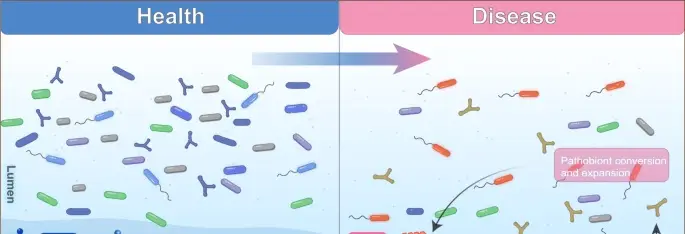
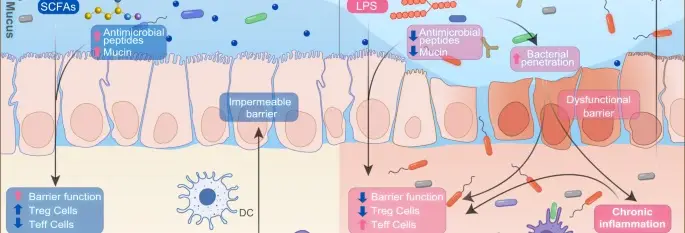
Fig.: Schematic representation of the healthy and diseased microbiome.

Subclinical clostridial contamination is not an acute problem, but rather a Chronic process, that builds up over weeks and months. That is precisely why it is enough not from, to use a product selectively or to „improve“ it at short notice during the season.

👉 Performance is only achieved when the gut is stabilised in the long term.

One Intestinal rehabilitation introduced at an early stage and strategically organised is therefore the decisive lever, ideally already long enough before the racing season and consistently throughout the season.


🧬 SymBiotic: Why the interaction of several probiotics really works

An efficient microbiome is No mono system, but a finely tuned ecosystem of different microorganisms with clearly distributed tasks.

This is precisely the decisive advantage of real SymBiotics.

The high-quality SymBiotic consciously uses the Interaction of several probiotics, which complement and reinforce each other:

  • Bacillus subtilis & Bacillus licheniformis
    → Enzyme dominance, competition suppression of clostridia, better feed utilisation
  • Pediococcus acidilactici & Enterococcus lactis
    → Lowering of the intestinal pH value, unfavourable environment for clostridia, stabilisation of the intestinal barrier
  • Bacillus velezensis
    → Broadly antimicrobial, immunomodulating, anti-inflammatory

Supplemented by Prebiotics (MOS & FOS) a real symbiotic system, that:

  • specifically promotes beneficial germs
  • binds pathogenic germs
  • closes ecological niches for Clostridia
  • and permanently stabilises the microbiome

👉 It is not a single strain that is decisive, but the functional interaction.


🕒 Why early & long-term is the decisive factor

A stable microbiome:

  • needs Time, to build yourself up
  • reacts sensitively to stress, flights, weather, food changes
  • must continuously maintained become

Therefore:

The earlier intestinal rehabilitation is started, the more stable the performance remains during the season.

Breeders who only react when performance has already been lost are often fighting against an already chronically disturbed balance.that the optimum effect of probiotic bacteria is only achieved with continuous daily intake.


🏁 Conclusion: take gut health seriously as a performance factor

The quintessence of all the findings is:

  • Clostridia are common not the real problem,
  • but a Symptom of an unstable microbiome.

In practice, this means

  • Regular Faeces analyses help to recognise subclinical problems at an early stage.
  • Antibiotics should not prophylactic, but only be used in a targeted manner.
  • After stress, the gut needs Active regeneration.

Only one Strategic, long-term intestinal rehabilitation with a genuine SymBiotic:

  • builds up the microbiome sustainably
  • protects against subclinical loss of performance
  • Improves regeneration, endurance and flight speed
  • and creates consistent form over the entire competition season

In this way, the basis for clostridial overgrowth is removed precisely where performance is lost unnoticed.


Conclusion for racing pigeon fanciers

Subclinical clostridia belong to the The most common but least recognised performance brakes in racing pigeon sport.
If you want to achieve top performance in the long term, you should Intestinal health of his pigeons just as consistently as training and feeding.


👉 You would like to optimise the intestinal health of your flock and get the full performance potential out of your pigeons.

Then start now with a targeted intestinal cleanse:
Faeces analysis
✔ Reduction of unnecessary burdens
✔ Use of high-quality Symbiotics for microbiome stabilisation

Tip: We now recommend a symbiotic intestinal cure daily for 2-3 weeks at a time.

Clostridia are intestinal bacteria that are normal in small quantities, but can impair performance if they overgrow.

What are clostridia in racing pigeons?

Can clostridia reduce flight performance?

How do you recognise subclinical clostridia?

Are antibiotics against clostridia useful?

What supports the intestinal health of racing pigeons?

BergerPearls No.1: How a single pearl is revolutionising racing pigeon feeding

The modern Racing pigeon breeding places ever greater demands on our feathered athletes. Whether in the Racing seasonduring the Mauser or in the Breeding, Pigeons should deliver top performance and stay healthy at the same time. To achieve this, breeders often resort to countless additional products: Probiotics for drinking water, vitamin powders in the feed, oils and grain mixtures. This routine not only costs time and labour, but also requires a lot of knowledge.

This is exactly where BergerPearls No.1 and revolutionises the Feeding: A single, innovative feed supplement combines Energydigestive support and Immune defence in small pearls. With just a handful of these "power pearls" a day, the pigeons get everything they need for a healthy diet. Healthperformance and fast regeneration.

The secret behind the pearl: gentle production for maximum effect

The key to the effectiveness of BergerPearls No.1 lies in its unique Pelletising process. Unlike conventional pellets or extruders, which are pressed under high pressure and heat, the production process is gentle and without any loss of nutrients. As a result, sensitive active ingredients such as live probiotics, vitamins and herbal extracts remain fully active.

Each pearl contains the complete combination of nutrients and active ingredients and is so small that it is ideal for mixing in with the normal grain feed. Your pigeons instinctively like to eat the pearls, as the base consists of flavoured peanut kernels. This process guarantees that all ingredients are protected until they are ingested by the pigeon and work optimally can.

Concentrated power in every pearl: unique ingredients

The true innovative power of BergerPearls No.1 is based on a large number of synergistically harmonised components.   The product is not a random mix, but a well thought-out overall concept that combines various mechanisms of action to support the health of the pigeons holistically. 

  • Highly digestible energyThe chopped peanut kernel base provides highly digestible crude fat and protein. These nutrients are crucial for rapid muscle recovery and the stamina required for long flights.
  • Healthy digestionAn intact intestinal microbiome is essential for the vitality of your pigeons. BergerPearls No.1 contains selected Probiotics (beneficial bacterial cultures) and Prebiotics (special dietary fibres as "food" for the microbiome). This combination stabilises the intestinal flora, displaces harmful germs and improves the absorption of nutrients. Regular daily administration ensures a continuous supply.
    Extra advantage in breeding: Studies show that parent birds supplied with probiotics produce more immunoglobulins in their crop milk. The young pigeons thus receive immune protection while still in the nest and grow up to be more resistant. This will benefit your entire breeding programme in the long term.
  • Natural immune booster: A strong Immune system is vital for racing pigeons, especially in the Racing season. The pearls are based on two natural components:
    Beta-glucans and Colostrum. Beta-glucans from yeast "wake up" the defence cells and make them more alert. Colostrum, the antibody-rich first milk, provides additional immunoglobulins that directly neutralise pathogens.
  • Protection against harmful germs: MCT oils (medium-chain fatty acids) act as a natural protection against germs by specifically breaking down the envelopes of pathogens such as clostridia, E. colisalmonella or streptococci in the intestine without affecting the beneficial intestinal bacteria. This creates a antibiotic-free protection from digestive disorders and infections, especially during periods of stress.
  • Essential micronutrients: The product provides a broad spectrum of Vitamins (A, D3, E, C) and chelated Trace elements. "Chelated" means that the minerals are bound to organic carriers, which means they are absorbed particularly well in the intestine. These vital substances support countless bodily functions, from intact mucous membranes and strong bones to robust growth and glossy plumage.
  • Detoxification for a safe gut: Toxin binder such as bentonite and clinoptilolite act like sponges, absorbing harmful substances and excess fluid in the digestive tract. This relieves the liver and significantly reduces the risk of indigestion or "wet faeces".

The following table provides a detailed overview of the main groups of active ingredients and their benefits:

Active ingredient groupFunction & benefit
Energy & protein base (peanut kernels)Provide highly digestible energy and protein for endurance and muscle recovery.
Essential active ingredients (vitamins, trace elements)secure metabolic processes, strengthen the immune system and ensure health and performance
Intestinal health (pro- & prebiotics)Stabilise the microbiome, promote beneficial bacteria and displace pathogens.
Selective protection (Medium-chain fatty acids)Have a selective antimicrobial effect against harmful germs without disturbing the intestinal flora.
Immune defence (beta-glucans, colostrum)Activate and modulate the body's own immune system for a faster response.
Nutrient utilisation (Digestive enzymes)Improve the absorption of nutrients from the forage.
Detoxification (Toxin binder)Bind harmful substances and excess moisture, relieve the liver and reduce diarrhoea.

Science meets practice: The unbeatable advantage for breeders

BergerPearls No.1 makes the Everyday feeding simpler and more effective. The concept means that a single product performs the functions of many separate supplements. Instead of measuring out several doses every day, you simply add one portion of the pearls to the food without missing out on the advantages and benefits of the many different products such as probiotics, conditioner powders, herbal extracts such as oregano oil blends, MCT preparations, immune boosters, multivitamins and others. Rather, the Feeding clean, simple and fast. Beginners benefit from the fact that their pets are fully catered for without complex feeding plans. Professionals appreciate the time saved and the certainty that no important nutrient or active ingredient is forgotten.

The pigeons usually accept BergerPearls No.1 from the very first day and favour it after just a few feedings. Daily feeding ensures a constant level of functional components in the intestines, which means that the pigeons show more stable vitality and are less susceptible to diseases. In the long term, this feeding is also very Cost-efficientas fewer individual products are required and healthier pigeons mean fewer losses in the long term. Whether in the Racing seasonin the resting phase, during the Mauser or to the BreedingWith this all-in-one solution, you always feed optimally. The result is more resilient flocks and more consistent flight performance, as only perfectly healthy pigeons can realise their full potential.

The pearls strengthen intestinal health, the immune system and regeneration through a synergistic combination of probiotics, beta-glucans, MCT oils and other functional ingredients.

How does BergerPearls No.1 support the health of racing pigeons?

Can BergerPearls No.1 completely replace other supplements?

How should BergerPearls No.1 be used correctly in daily feeding?

Is the product also suitable for young pigeons, moulting and breeding?

What role do MCT oils play in BergerPearls No.1?

What makes BergerPearls No.1 so unique for feeding racing pigeons?

Are the ingredients of BergerPearls No.1 scientifically proven?

Ask the Berger is back - expert knowledge for racing pigeon fanciers live & compact

Ask the Berger: Back at BergerPIGEONS - live, compact & close to the breeder

There are formats that you miss when they are missing. "Ask Berger live" was one of them.
Launched in 2020, it offered pigeon fanciers the opportunity for the first time to ask questions at any time or live and receive expert, practical answers.

Many growers appreciated the unique blend of scientific expertise, practical experience and honest communication.
After the end of my previous job, I received numerous messages:

"We miss you, because with you there was more depth."

This feedback motivated me to revive "Ask the Berger" under BergerPIGEONS.

The new "Ask the Berger", two formats, more knowledge, more practice

  1. Ask the Berger live

📅 Every Monday at 12:00 noon on YouTube & Facebook.

  • You ask your questions, I answer them live, directly, honestly and practically.
  • No lists of topics, but answers to what is currently on the minds of breeders.
  • If I can't answer something immediately, I do some research and provide the answer later.
  • New to the programme: David Balka young, inquisitive breeder. He asks exactly the same questions that many other breeders are asking and makes the format even more lively.
  •  Ask the Berger compact
  • Short videos (2-3 minutes), each with a clearly answered question.
  • Ideal for quickly acquiring knowledge.
  • Also translated into other languages - so that breeders worldwide can benefit.
  • Up to 3 episodes per week - compact, up-to-date and available at any time.

Why is it worth being there?

As a racing pigeon fancier, you can obtain the "Ask the Berger" programme:

  • Direct expert knowledge - from over 40 years of breeding experience and biological expertise.
  • Immediately realisable tips on Feeding, health, breeding, training and regeneration.
  • The latest scientific findings, explained clearly and comprehensibly.
  • More security in dealing with Products, care & management of your racing pigeons.

No matter whether Feed, immunity, metabolism, stroke construction or training plans, Every question is welcome.

So you don't miss anything

  • 📅 Live dates: every Monday, 12:00 pm on YouTube & Facebook
  • 📺 All episodes: available at any time on my website & YouTube channel
  • 📧 Newsletter: Registration on www.bergerpigeons.com, exclusive tips, reminders & background knowledge

Conclusion

"Ask the Berger" is back, more direct, more practical and more versatile than ever before.
Whether live or compact: you ask the questions, I provide the answers.

Join us and become part of the BergerPIGEONS-Community!

"Ask the Berger" is an interactive format for racing pigeon fanciers with live questions & compact video answers.

What is "Ask the Berger"?

When does "Ask the Berger live" take place?

What topics does "Ask the Berger" cover?

What is the difference between "live" and "compact"?

How can I never miss an episode?