BergerPIGEONS > Blog > Article of the Month > Moulting – The feather is merely the visible result – but of what, exactly?
Moulting – The feather is merely the visible result – but of what, exactly?
Why the most important preparations for the next travel season begin as early as the moulting season
„After the journey is before the journey.“
There is hardly a statement you hear more often in the world of carrier pigeon racing. And indeed: after weeks of intense races, things finally seem to be calming down. The pigeons are flying less, the strain is easing, and attention is turning to the regrowth of their plumage.
From a biological point of view, however, one of the most demanding phases of the whole year is now beginning. Moulting is not a break. It is a major biological undertaking.
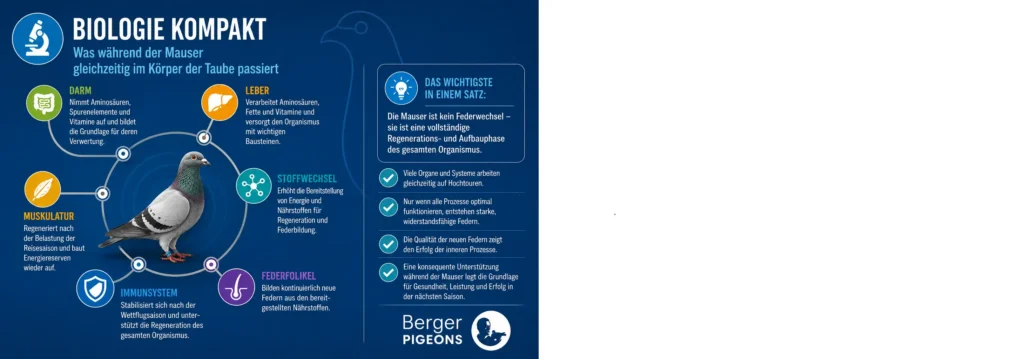
Whilst we as fanciers only see the feathers that are falling out and the new ones growing in, countless processes are taking place simultaneously inside the pigeon. The metabolism is working at full speed. The liver processes enormous quantities of nutrients. The muscles are regenerating after the stresses of the racing season. The immune system is stabilising. At the same time, a completely new plumage develops within a few weeks.
The spring is therefore not the actual process. It is merely the visible result.
Why many breeders misjudge the moulting process
Most breeders judge moulting almost exclusively on the basis of the plumage.
„The feathers are falling.“
„The feathers are growing.“
„The plumage looks good.“
This makes the spring itself the centre of attention.
Strictly speaking, however, one would have to look back much further.
For not a single feather grows of its own accord. Every feather is the end product of a complex biological process. Before it becomes visible, millions of new cells must be formed every day, proteins synthesised, amino acids supplied, minerals incorporated and energy converted.
In other words:
The spring simply shows how well the organism has functioned.
Anyone who looks only at the plumage is merely judging the end result – not the journey to get there.
The moult is one of the biggest biological projects of the year
Hardly any other phase poses comparable challenges to a carrier pigeon’s body.
After a long travel season, numerous systems need to recover whilst continuing to operate at full capacity.
These include, amongst others:
the liver as the body’s metabolic centre,
the gut as the site of nutrient absorption,
the muscles following the high G-forces experienced during flight,
the immune system,
the entire protein and energy metabolism.
At the same time, almost the entire plumage is being replaced.
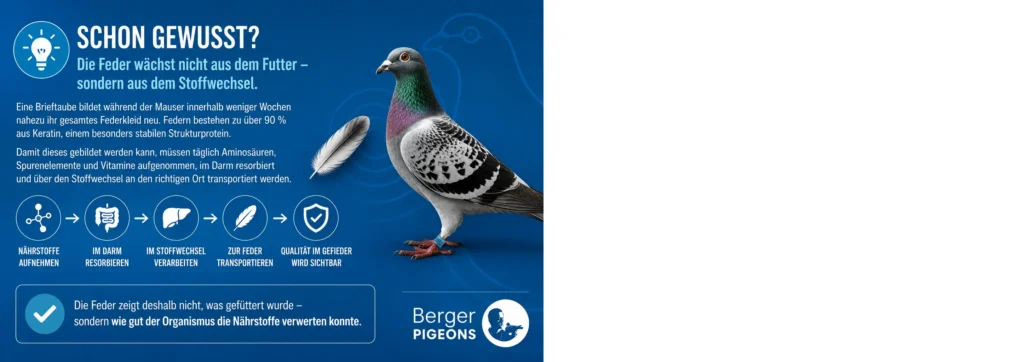
Feathers consist mainly of keratin – an extremely strong structural protein. Considerable amounts of high-quality amino acids are required daily to build this protein, particularly methionine and cystine. At the same time, the need for trace elements such as zinc, copper and manganese, as well as various vitamins, increases significantly.
However, these building blocks can only be utilised if they can be absorbed and processed by the body in the first place.
This is exactly where the actual moulting begins.
Without a healthy gut, there can be no high-quality quill
When it comes to moulting, many breeders think first and foremost of protein. In fact, however, successful feather development begins much earlier – namely in the gut. This is where it is determined whether amino acids, vitamins and trace elements can be absorbed at all. If the gut microbiome is disrupted or the intestinal mucosa is compromised, even high-quality nutrients can only enter the body to a limited extent.
A healthy gut therefore means far more than just good digestion. It forms the basis for ensuring that all the building blocks for regeneration and feather formation are available in the first place. At the same time, a large part of the immune system is located in the gut-associated tissue. Gut health therefore influences not only nutrient supply but also general resilience during this demanding phase.
The liver – the real conductor of the moult
Once the nutrients have been absorbed, the liver begins its work. It decides which substances are to be processed, stored or made immediately available for regeneration.
The liver regulates fat metabolism, processes amino acids, synthesises numerous endogenous proteins and supplies the body with the building blocks required for the formation of new feathers.
This organ is under particular strain, especially after a long travelling season. For this reason, moulting should not be viewed solely in terms of feather growth. Above all, it is a phase of intensive metabolic regeneration.
A lot of protein doesn’t automatically mean a lot
There is still a widespread belief that birds should be fed as much protein as possible during the moulting season. From a biological perspective, however, this approach falls short. It is not the absolute amount of protein that determines success, but the quality of the amino acids it contains.
If certain essential amino acids are lacking, the body can only make limited use of the remaining protein components. Excess protein is not simply converted into better feathers, but must be metabolised through a complex process. At the same time, energy intake often increases, which can lead to the build-up of unnecessary fat reserves.
It is therefore crucial to ensure a continuous supply of the nutrients that are actually limiting – tailored to the biological requirements during the moulting period.
Regeneration means far more than just the formation of new tissue
The biggest misconception is to view moulting solely as a change of feathers. In fact, the entire organism regenerates during this period.
The muscles recover from the stresses of the racing season. Energy reserves are replenished. Damaged tissue is repaired. The immune system stabilises. At the same time, the foundations are laid for the coming breeding and racing season.
A pigeon that emerges from this phase with a stable metabolism, a healthy liver, a healthy gut and fully regenerated muscles starts the new year under completely different conditions to a pigeon that has not adequately managed these biological processes.
The next holiday season does not begin in spring
Many breeders invest a great deal of time in training, feeding and preparation in the spring. However, the biological conditions necessary for top performance are established much earlier. They are established now. During the moulting season.
This is what determines how fully the bird’s body regenerates, the quality of its new plumage, and the reserves with which the pigeon begins the next season.
That is why preparations for the next flying season do not begin with the first training flight.
It begins with a thorough recovery period immediately following the last prize trip.
Our conclusion
Anyone who regards moulting solely as a change of feathers is significantly underestimating its biological significance.
The plumage is merely the visible result of a highly complex interplay between gut health, liver function, metabolism, regeneration and an adequate supply of all the necessary nutrients.
This is precisely why the BergerPIGEONS system takes a holistic approach: the focus is not on individual products, but on the biological processes that determine health, recovery and performance.
After all, each feather ultimately reveals how well the organism has functioned in the weeks leading up to that point.
How to put this knowledge into practice
Biological principles form the basis – but what is crucial is applying them consistently in everyday life.
That is why, drawing on the latest scientific findings and our many years of practical experience, we have developed a BergerPIGEONS Mauser Care Plandeveloped. It explains, step by step, how you can specifically support your bird’s metabolism, gut, liver and feather development throughout the moulting period.
You now know why moulting is such a demanding biological process. Our BergerPIGEONS moulting care plan, as well as our A detailed practical guide to moulting.
Many breeders base their decisions on the visible moult. In fact, the biological changes begin much earlier and affect the entire organism.
Feathers are not simply made up of egg white. The liver processes and distributes the nutrients absorbed, thereby playing a key role in feather formation.
It is not the amount of protein that matters, but the availability of the right amino acids, trace elements and vitamins, and their absorption via a healthy gut.
A firm, supple and lustrous spring is no accident. It is the visible result of a healthy metabolism, a healthy liver, a healthy gut and effective regeneration.
Recovery after the breeding season and the growth of a new plumage lay the biological foundations for health, performance and resilience in the coming year.
Does moulting really only begin when the first primary feather falls out?
Many breeders base their decisions on the visible moult. In fact, the biological changes begin much earlier and affect the entire organism.
Why does the liver determine the quality of the new feathers?
Feathers are not simply made up of egg white. The liver processes and distributes the nutrients absorbed, thereby playing a key role in feather formation.
Is it enough to feed them extra protein during the moulting season?
It is not the amount of protein that matters, but the availability of the right amino acids, trace elements and vitamins, and their absorption via a healthy gut.
What does a high-quality feather really reveal about a pigeon?
A firm, supple and lustrous spring is no accident. It is the visible result of a healthy metabolism, a healthy liver, a healthy gut and effective regeneration.
Why do preparations for the next travel season begin as early as the moulting season?
Recovery after the breeding season and the growth of a new plumage lay the biological foundations for health, performance and resilience in the coming year.
Was this article helpful?
Share this article with colleagues or friends. I am always happy to welcome new readers to the BergerPIGEONS blog.
How can a training flight be assessed objectively? Jürgen von Ramin documented the home-based training of his young pigeons using precise GPS data and weather readings. His report shows how regular training, good health and verifiable measurement data combine to provide a fascinating snapshot of pigeon racing – without exaggeration and with a deliberately objective view of the results.
When I developed BergerPearls No. 1, my aim was clear from the outset. Caring for carrier pigeons should be made easier. Not more complicated. Not more labour-intensive. And certainly not should the fancier have to moisten different powders every day and mix them into the feed. As a biologist, product developer and long-standing carrier pigeon fancier, I have been involved in this field for many years […]
Why the most important preparation for the next racing season begins during the moulting period „After the race is before the race.“ There is hardly a saying you hear more often in the world of carrier pigeon racing. And indeed: after weeks of intense races, calm finally seems to be setting in. The pigeons are flying less, the strain is easing, and attention turns to the regrowing plumage. […]
Discover functional products that are scientifically based and proven in practice - developed for better health, performance and regeneration.
With clear recipes, high acceptance and real added value for breeders and pigeons.
Easy to use - strong results.