BergerPIGEONS > Blog > Advice > Clostridia in the intestines of racing pigeons: an invisible brake on performance during the racing season
Clostridia in the intestines of racing pigeons: Invisible brake on performance during the racing season
Or, why do healthy pigeons lose performance during the season?
Many growers are familiar with this phenomenon: The pigeons appear healthy on the outside, the training is good, the feed is of high quality and yet the hoped-for results do not materialise. The animals do not come home sick, but noticeably later.
An often overlooked factor lies inside the pigeon: Intestinal health. To be more precise Subclinical clostridial contamination in the intestine can significantly impair performance without causing classic symptoms of illness.
Clostridia - a natural inhabitant with a serious risk
Clostridia are anaerobic, spore-forming bacteria that occur naturally in the intestines of racing pigeons. In small quantities, they are part of the normal intestinal flora.
It becomes problematic when the Microbiological balance is disturbed, for example by
Stress during the racing season
Feed changes
Antibiotic administration
Concomitant infections
In such situations, clostridia can multiply rapidly, Form toxins and irritate the intestinal mucosa, often without causing visible diarrhoea or acute illness.
In these so-called subclinical courses, the pigeons appear healthy, but sometimes show dull plumage, delayed regeneration and poor form.
Straight Young pigeons, Old pigeons after hard flights or after 6-8 flights in the course of a season and increasingly often flocks after medication are particularly susceptible. The result: the pigeon flies below their capabilities.
Science & practice: What we know
Direct studies on the influence of subclinical Clostridia on the flight performance of racing pigeons are still lacking. However, numerous studies from the field of poultry science show that Clostridium perfringens can be found in other bird species even without severe symptoms. Significant loss of performance caused.
Microbiome studies also provide clear evidence: 👉 A stable gut microbiome is a key prerequisite for health and performance.
These findings are consistent with the many years of experience of specialised racing pigeon veterinarians: pigeons with an unclear weakness of form often show increased clostridia levels and their results improve significantly as soon as the intestines are specifically stabilised.
🔬 Why strategic gut reorganisation is the key to performance
The central finding from science and practice is clear: A damaged or unstable gut microbiome does not regenerate by itself and certainly not in the short term.
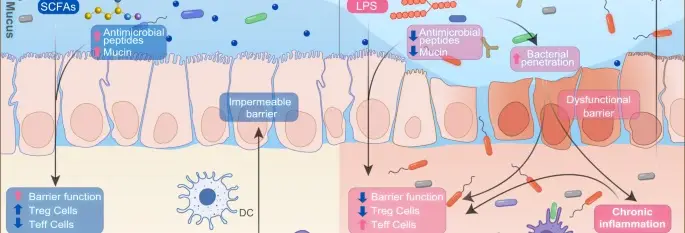
Fig.: Schematic representation of the healthy and diseased microbiome.
Subclinical clostridial contamination is not an acute problem, but rather a Chronic process, that builds up over weeks and months. That is precisely why it is enough not from, to use a product selectively or to „improve“ it at short notice during the season.
👉 Performance is only achieved when the gut is stabilised in the long term.
One Intestinal rehabilitation introduced at an early stage and strategically organised is therefore the decisive lever, ideally already long enough before the racing season and consistently throughout the season.
🧬 SymBiotic: Why the interaction of several probiotics really works
An efficient microbiome is No mono system, but a finely tuned ecosystem of different microorganisms with clearly distributed tasks.
This is precisely the decisive advantage of real SymBiotics.
The high-quality SymBiotic consciously uses the Interaction of several probiotics, which complement and reinforce each other:
Pediococcus acidilactici & Enterococcus lactis → Lowering of the intestinal pH value, unfavourable environment for clostridia, stabilisation of the intestinal barrier
Supplemented by Prebiotics (MOS & FOS) a real symbiotic system, that:
specifically promotes beneficial germs
binds pathogenic germs
closes ecological niches for Clostridia
and permanently stabilises the microbiome
👉 It is not a single strain that is decisive, but the functional interaction.
🕒 Why early & long-term is the decisive factor
A stable microbiome:
needs Time, to build yourself up
reacts sensitively to stress, flights, weather, food changes
must continuously maintained become
Therefore:
The earlier intestinal rehabilitation is started, the more stable the performance remains during the season.
Breeders who only react when performance has already been lost are often fighting against an already chronically disturbed balance.that the optimum effect of probiotic bacteria is only achieved with continuous daily intake.
🏁 Conclusion: take gut health seriously as a performance factor
The quintessence of all the findings is:
Clostridia are common not the real problem,
but a Symptom of an unstable microbiome.
In practice, this means
Regular Faeces analyses help to recognise subclinical problems at an early stage.
Antibiotics should not prophylactic, but only be used in a targeted manner.
After stress, the gut needs Active regeneration.
Only one Strategic, long-term intestinal rehabilitation with a genuine SymBiotic:
builds up the microbiome sustainably
protects against subclinical loss of performance
Improves regeneration, endurance and flight speed
and creates consistent form over the entire competition season
In this way, the basis for clostridial overgrowth is removed precisely where performance is lost unnoticed.
Conclusion for racing pigeon fanciers
Subclinical clostridia belong to the The most common but least recognised performance brakes in racing pigeon sport. If you want to achieve top performance in the long term, you should Intestinal health of his pigeons just as consistently as training and feeding.
👉 You would like tooptimise the intestinal health of your flock and get the full performance potential out of your pigeons.
Then start now with a targeted intestinal cleanse: Faeces analysis ✔ Reduction of unnecessary burdens ✔ Use of high-quality Symbiotics for microbiome stabilisation
More energy. More stability. More willingness to perform during the racing season. When racing pigeons go on races, they perform exceptionally well, with their metabolism working at full speed during endurance flights at up to 10-15 times the resting metabolic rate. While other animal species mainly rely on carbohydrates during exercise, racing pigeons mainly use fat as an energy source. This is precisely where their enormous endurance potential lies - but also a [...]
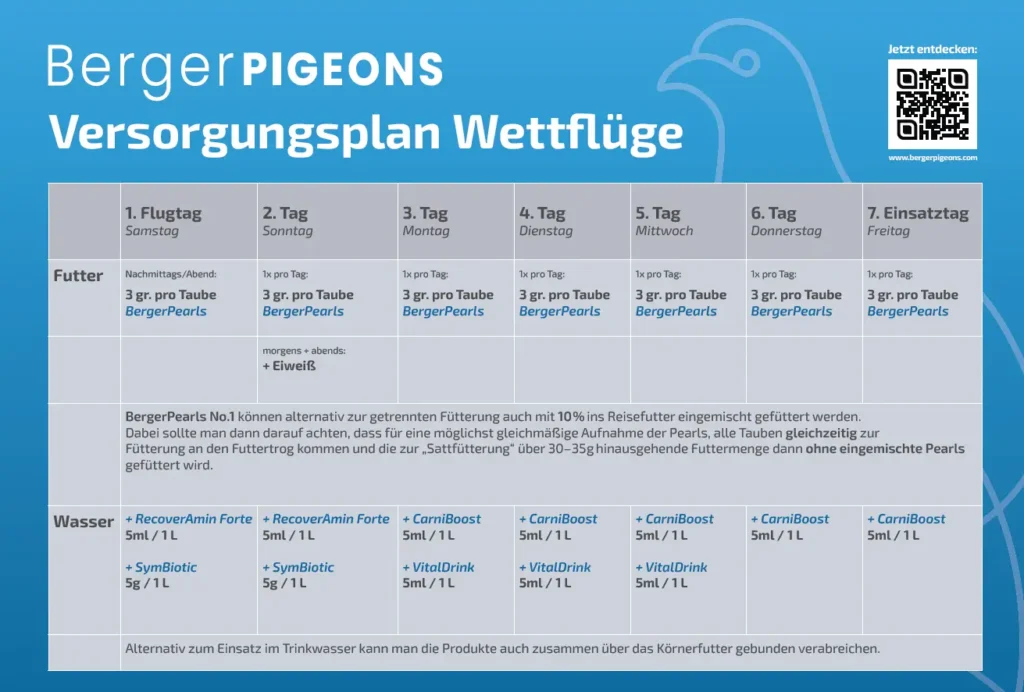
With the new menu item „Care plans“, BergerPIGEONS now provides a practice-orientated plan that starts exactly where races are decided: in the days between two races. The newly published care plan for the phase between races is aimed at racing pigeon fanciers who want to clearly structure their feeding, supplementation and support without having to put their pigeons in a [...]
Or, why do healthy pigeons lose performance during the season? Many fanciers are familiar with this phenomenon: the pigeons appear healthy on the outside, the training is good, the feed is of high quality and yet the hoped-for results do not materialise. The animals do not come home sick, but noticeably later. An often overlooked factor lies within the pigeon: intestinal health. To be more precise [...]
Discover functional products that are scientifically based and proven in practice - developed for better health, performance and regeneration.
With clear recipes, high acceptance and real added value for breeders and pigeons.
Easy to use - strong results.